 Conéctate con Google
 Conéctate con Facebook

Impresión 3D del Jet Fusion PA12
Tecnología HP Jet Fusion
Acceder
Si tiene dificultades accediendo a su cuenta, contáctenos.
Registrarse
Para empezar a realizar impresiones en 3D o cortes por láser, primero tienes que crearte una cuenta aquí. Una vez hecho eso, podrás subir archivos y generar instantáneamente los precios de tus componentes.
¿Ya tiene una cuenta? Iniciar sesión
Colors


Finishes
Characteristics
ABS (Acrylonitrile Butadiene Styrene) is a thermoplastic widely used in product manufacturing and industrial 3D printing. Known for its balance of rigidity, toughness and impact resistance, ABS is used for applications ranging from equipment housings to functional prototypes.
The material combines three constituents with complementary properties. Acrylonitrile contributes to chemical resistance and thermal stability, butadiene provides toughness, and styrene contributes to rigidity and ease of processing. The resulting plastic offers a versatile combination of properties for engineering and product development.
For ABS 3D printing, the material is supplied as a filament and processed using Fused Deposition Modeling (FDM), also known as Fused Filament Fabrication (FFF). The printer heats and extrudes the filament layer by layer to manufacture a part directly from your 3D model.
ABS is a useful option when your project requires a rigid plastic part that can withstand handling and mechanical use.
Its combination of stiffness and toughness makes it suitable for functional prototyping, while its heat resistance can be beneficial for applications where operating temperatures influence material selection. The exact suitability depends on the ABS grade, the applied load and the conditions of use.
Key benefits of ABS
ABS plastic can be used for a broad range of product development and industrial applications. FDM 3D printing enables you to manufacture custom parts, evaluate design changes and produce components adapted to your assembly or workflow.
Test your design with ABS prototypes that help you evaluate shape, fit and functionality.
From brackets to mechanical covers, printed components allow you to compare design iterations and identify improvements before committing to production tooling. Functional testing should account for the layered structure of FDM parts.
Create custom ABS housings, equipment enclosures and protective covers.
Integrate mounting points, cable openings and internal supports directly into your 3D model. ABS offers a practical combination of rigidity and toughness for enclosure prototypes and selected functional housings.

Assembly and fit-check models
Verify how components fit together with 3D printed assembly models.
Use ABS parts to check clearances, positioning and access to attachment points. This helps identify interference and assembly issues early in product development.

Adapt your assembly process with custom jigs, positioning aids and fixtures.
ABS can be considered for workshop tooling that requires rigidity and resistance to handling. Material suitability depends on the expected loads, operating temperatures and frequency of use.

Produce customized mounts, holders and brackets for equipment and accessories.
Reinforcement, wall thickness and build orientation should be selected according to the expected stresses, particularly around fastening points.

ABS can also be considered for end-use plastic components when its properties meet the application’s requirements.
Assess the operating environment, mechanical loads and required service life before selecting the material. Testing may be necessary to validate the performance of the finished part.
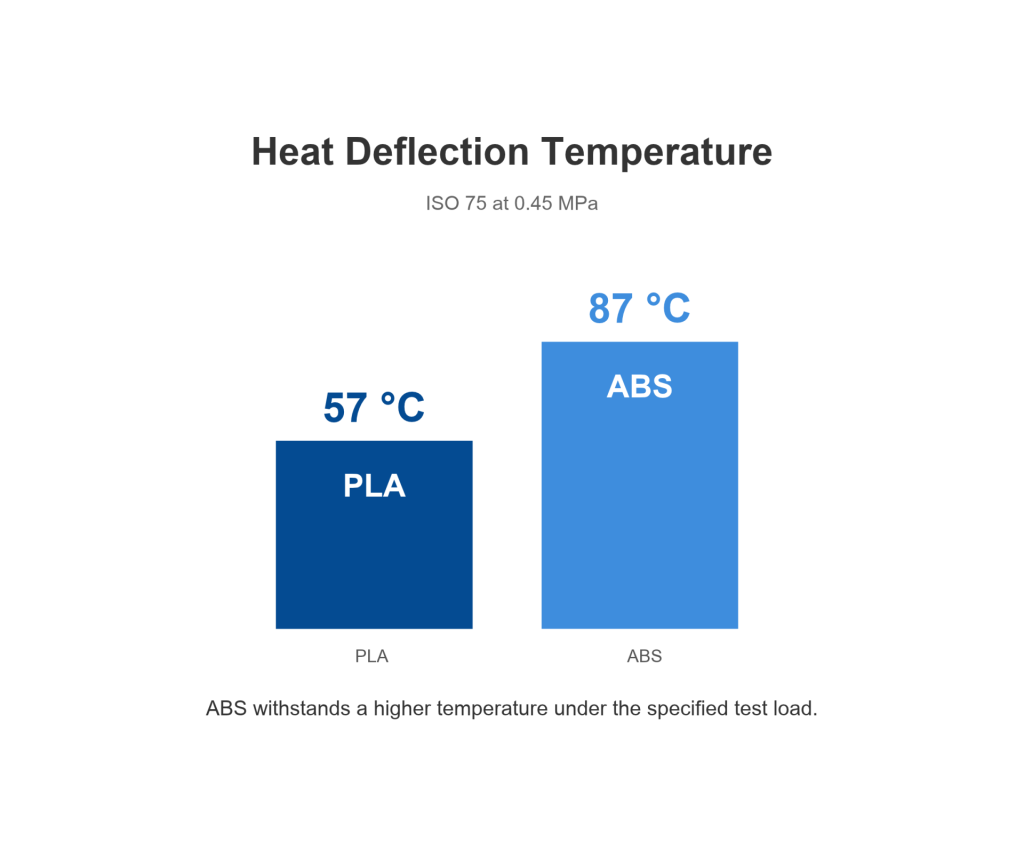
ABS and PLA are both widely used for filament 3D printing, but they serve different project requirements.
PLA is often selected for visual prototypes, presentation models and fit checks. ABS is commonly considered for functional prototypes and components where toughness and heat resistance are more important.
The choice depends on the purpose of your part. A model intended to demonstrate a product’s shape may have different requirements from a housing that must withstand repeated handling or elevated temperatures.
For functional applications, compare the technical specifications of the available materials and consider the performance of the printed part, rather than the plastic alone.
The price of your ABS part depends on its dimensions, geometry, production quantity and manufacturing requirements.
For FDM printing, material consumption, printing time, wall thickness, infill and support structures all influence the final cost. Additional finishing requirements can also affect pricing and lead time.
Optimizing your design may help reduce manufacturing costs. Appropriate walls and infill, fewer support-dependent features and a suitable build orientation can improve production efficiency while meeting your application’s requirements.
Submit your 3D file and project requirements to obtain pricing and an estimated production schedule. Delivery time should be added to processing time.
For more information, please check our pricing page.
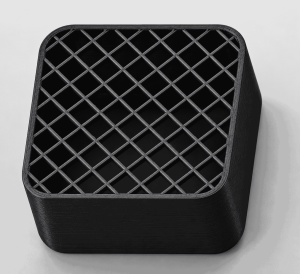
20% infill density on a 35mm large element
Sculpteo uses Fused Deposition Modeling (FDM) to manufacture ABS parts layer by layer.
ABS filament is fed into a heated printhead, where it softens and is extruded through a nozzle. The printer follows toolpaths generated from your digital model, depositing the material onto a build platform.
Each deposited layer cools and bonds with the previous one until the part is complete. Depending on the design, temporary support structures may be required beneath overhangs or other unsupported features. These supports are removed after printing.
FDM also allows the internal structure of the object to be adjusted through its infill. The combination of outer walls and internal infill influences weight, material consumption and mechanical performance.
Because the part is built in layers, its strength can vary with the direction of the applied load. Build orientation is therefore an important consideration for functional ABS components.
Sculpteo’s ABS material is available in blue, white, black, red, yellow, green and orange.
ABS printed parts have the layered surface appearance characteristic of FDM technology. Layer visibility varies according to the geometry, build orientation and printing settings.
Areas in contact with support structures may show marks after support removal. If appearance is important, consider the placement of visible surfaces when designing your part.
For a project requiring a particular surface quality, contact our team to discuss the available finishing options.
Maximum size | 340 x 320 x 340 mm |
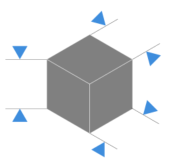
The maximum size of your models are limited by the physical size of our 3D printers – If you’d like to produce larger parts, please contact us! |
Standard Layer thickness: 250 µm
Standard NFT 58000 Normal class (category 3)
|
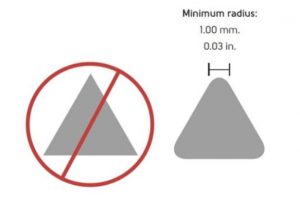
Knife edges/pointed edges will likely to fail during the print process. Round all knife edges with a 1.00 mm (0.03 in.) radius to avoid failing edges.
Minimum wall thickness:
1.2 mm
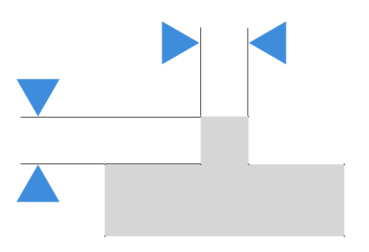
Stemmed elements with support:
1.25 mm
Stemmed elements without support:
1.25 mm


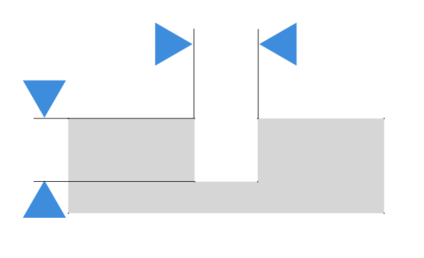
Minimum height and width details: Embossed : 3mm
Engraved : 0.8
Ratio Depth / width: N/A
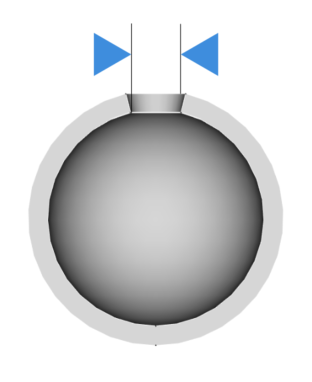
Enclosed parts? No
Interlocking parts? No
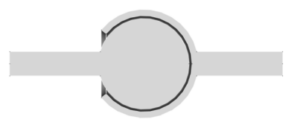
Minimum spacing between fixed walls:
0.5 mm
Minimum clearance between parts:
0.5 mm
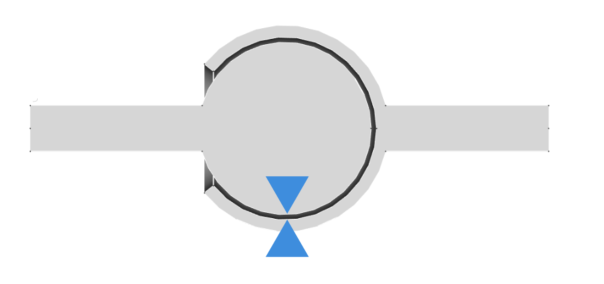
Hollowing? No
Angles under 45° require support structures.
Please keep in mind that surfaces that have connection with support won´t be as smooth as the surfaces without support.
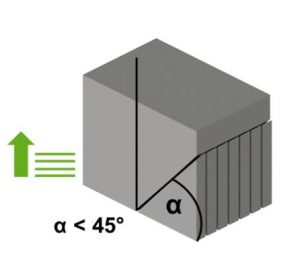
Support structures on edges, holes and corners are difficult to remove and sometimes it is not possible to do so.
| Property | Typical value | Test method reported |
|---|---|---|
| Density | 1.10–1.15 g/cm³ | ASTM D792 |
| Tensile modulus | 2,174 ± 285 MPa | ASTM D638 |
| Maximum tensile stress | 33.3 ± 0.8 MPa | ASTM D638 |
| Elongation at break | 2.7 ± 0.4% | ASTM D638 |
| Flexural modulus | 1,339 ± 238 MPa | ASTM D790 |
| Flexural strength | 59.0 ± 1.3 MPa | ASTM D790 |
| Impact strength | 12.6 ± 1.1 kJ/m² | ASTM D256 |
| Glass transition temperature | 98.1°C | DSC, 10°C/min |
| Softening temperature : 1.75 mm filament | 100–110°C | Custom method |
ABS stands for Acrylonitrile Butadiene Styrene, the three components that give this thermoplastic its name.
ABS is used for a wide variety of plastic components. In 3D printing, potential applications include functional prototypes, housings, protective covers, assembly models and selected jigs and fixtures.
ABS can be suitable for functional parts when its properties meet the application’s requirements. Part geometry, build orientation, wall thickness and infill all influence performance.
ABS is a rigid thermoplastic. It can tolerate some deformation, but it is not intended for applications requiring the elasticity of a flexible material such as TPU.
ABS offers heat resistance that can be useful for functional applications. The acceptable operating temperature depends on the exact grade, the applied load and the duration of exposure. Consult the material’s technical data before selecting it for a temperature-sensitive project.
FDM parts can be manufactured with different internal structures. Depending on the production settings, a part may have solid outer walls surrounding a partially filled interior. The appropriate infill depends on your requirements.
ABS is available in blue, white, black, red, yellow, green and orange.
With Sculpteo’s online 3D printing service you’re just a few clicks away from professional rPET 3D printing. Your 3D model is printed with the highest quality and delivered straight to your door.
Get started now to get your rPET prints!
Tecnología HP Jet Fusion