
3D learning Hub

Glass transition temperature: Definition and role in polymers

Key-takeaways:

  • The glass transition temperature (Tg) corresponds to the point where a polymer changes from a rigid and brittle state (glassy state) to a more flexible and rubbery state. It is a structural transition, different from the melting point.
  • It mainly concerns amorphous or partially crystalline materials, and directly influences key properties such as dimensional stability, stiffness, and heat resistance.
  • Tg is crucial when selecting materials for additive manufacturing, particularly in 3D printing. It impacts the performance of parts depending on their final application and thermal stresses.
  • It can be measured using methods such as DSC (Differential Scanning Calorimetry) or DMA (Dynamic Mechanical Analysis), and depends on several factors: chemical structure, cooling rate, composition, and manufacturing process (injection molding, casting, 3D printing).

Definition of glass transition temperature

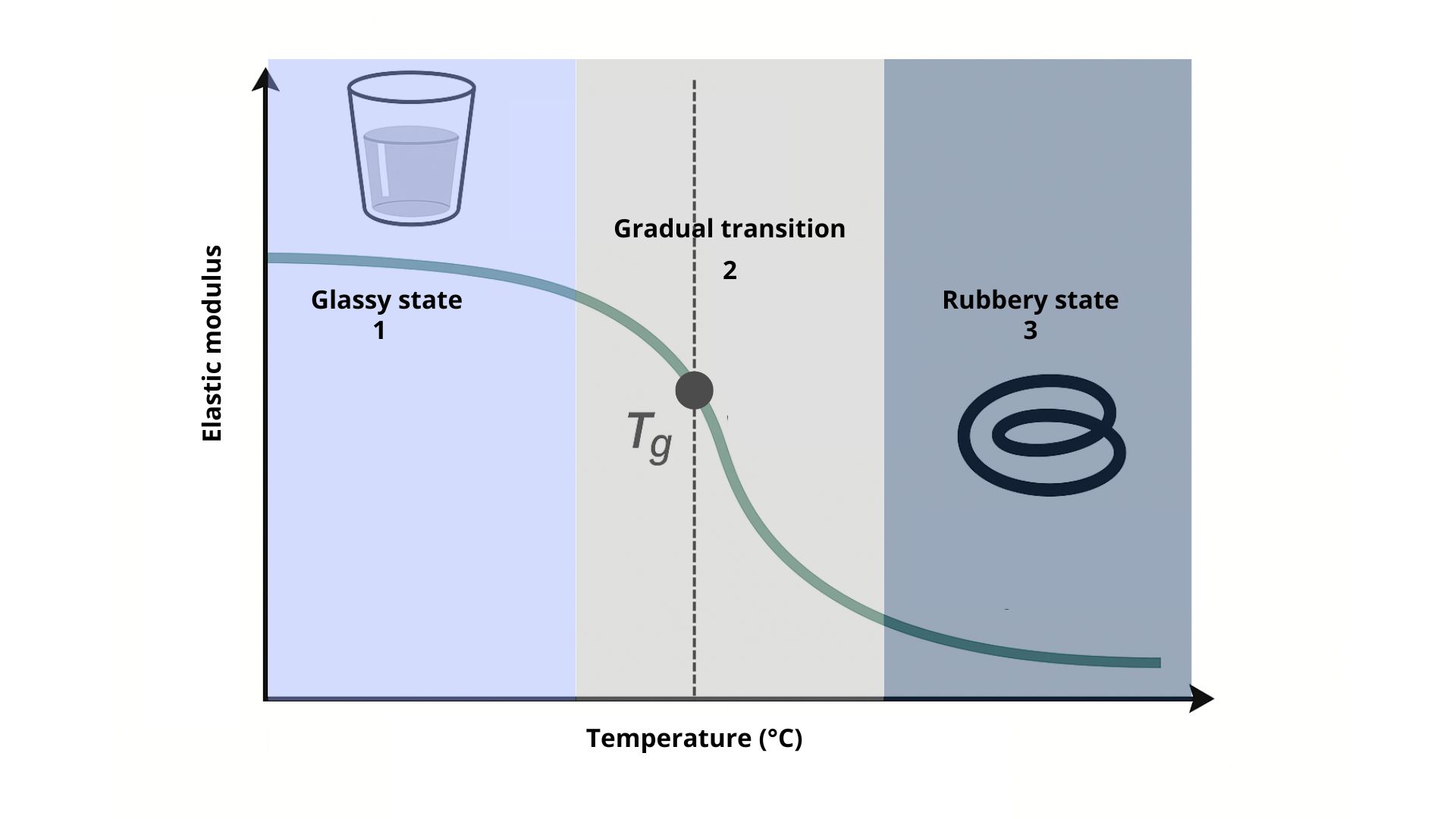
The glass transition temperature (Tg) is a critical thermal threshold in materials science. It is the temperature at which an amorphous material changes from a hard and brittle state to a more flexible and rubbery state. Unlike the melting temperature, Tg does not mark a clear phase transformation, but rather a gradual change in mechanical and thermal properties. This transition plays a fundamental role in understanding polymer behavior, both in additive manufacturing and injection molding.

Glass transition temperature curve

What is the glass transition temperature (Tg)?

Tg is specific to amorphous materials or the amorphous regions of semi-crystalline materials. Below this temperature, the molecular chains are locked in a rigid, disordered but stable structure. When the material is heated above Tg, these chains begin to move, making the material more flexible and even deformable. This structural change is crucial for adapting the shapes, tolerances, and performance of a part to its intended use. It depends not only on the chemical composition, but also on factors such as the cooling rate or the additives used.

Plastique température de transition vitreuse

Which materials are affected by the glass transition?

Polymers are the main materials affected by the glass transition, and this property plays a key role in selecting materials for 3D printing. At Sculpteo, several materials have a well-identified Tg. Among resins, standard SLA materials whether rigid or flexible are also influenced by their Tg. In addition, the polyurethane materials used in DLS technology show distinct values: rigid polyurethane has a Tg close to 80 °C, while elastomeric polyurethane has a much lower Tg, around –10 °C, explaining its high flexibility at room temperature. These differences in thermal behavior are essential to consider for ensuring the dimensional stability and strength of printed parts according to their usage conditions.

Other materials such as standard SLA resin, rigid or flexible resins, and TPU also exhibit properties influenced by their glass transition temperature. The glass transition of polymers is therefore a decisive factor in material selection, both for dimensional stability and mechanical strength.

Which physical properties are related to Tg?

Tg is directly linked to several essential physical properties: stiffness, elasticity, coefficient of thermal expansion, storage modulus, and the ability to dissipate heat. Below Tg, a polymer retains a fixed, rigid shape but can become brittle. Above it, the material gains flexibility but loses stability. This behavior strongly affects the dimensional stability of parts, their wear or impact resistance, and their suitability for molding or injection processes. Properly positioning Tg within the intended operating temperature range is therefore a strategic factor.

What are the methods for measuring Tg?

Thermal analysis is essential for determining the glass transition temperature. Several methods exist:

  • DSC (Differential Scanning Calorimetry), which tracks the variations in heat absorbed or released by the material during a controlled thermal cycle.

  • DMA (Dynamic Mechanical Analysis), which measures changes in storage modulus or loss modulus as a function of temperature and applied frequency.

  • Dilatometry, which detects dimensional changes linked to the thermal expansion of the polymer.

  • Monitoring the refractive index, which helps identify optical transitions correlated with Tg.

Each of these techniques provides a precise thermal curve, essential for comparing polymer materials, validating their stability, and optimizing manufacturing parameters according to usage constraints.

What factors influence the glass transition temperature?

Many factors influence Tg: the chemical structure of the polymer chains, the molecular weight, the presence of plasticizers, and especially the cooling rate during molding. Rapid cooling favors a disordered glassy state, while slow cooling can allow crystalline reorganization, shifting the Tg. The polymer chemistry is also decisive: rigid chains will have a higher Tg, while flexible or branched chains will have a lower one. Thus, both composition and processing have a major impact.

Examples of glass transition temperatures for Sculpteo materials

Here are some examples of typical Tg values for polymers frequently used in 3D printing:

Material Nylon PA12 Polypropylene Rigid Polyurethane Elastomeric Polyurethane VeroWhite VeroClear
Technology SLS / HP Jet Fusion HP Jet Fusion DLS Technology DLS Technology PolyJet Technology PolyJet Technology
Approximate Tg 55°C – 6°C / – 4°C 80°C – 10°C 52 -54 °C 52 – 54 °C

Role of the glass transition in plastic injection molding

In injection molding, Tg guides the heating, cooling, and demolding conditions. Injecting an amorphous polymer within a range close to Tg can sometimes allow more precise shaping with fewer internal stresses. This reduces the risks of shrinkage, warping, or cracking. For semi-crystalline materials such as PA12, Tg provides useful insights for adjusting the thermal cycle alongside the melting temperature.

Glass transition and additive manufacturing: A key parameter

In additive manufacturing, Tg determines the dimensional stability of printed parts, especially during thermal post-processing, drying, or chemical smoothing. For example, during vapor smoothing of PA12 or polypropylene parts, staying below Tg ensures the original shape is preserved. In SLA printing, rigid resins may soften if Tg is exceeded during post-curing or in actual use. Thus, the glass transition directly influences the performance, durability, and strength of printed objects.

The importance of glass transition in industrial sectors

The glass transition temperature is essential in many industries: automotive, medical, aerospace, electronics, sports, and industrial design. It determines the product’s behavior in real use, its longevity, and reliability. An electronic component exposed to temperatures above Tg may lose rigidity, compromising its functionality. Conversely, a medical device that is too rigid at room temperature can become flexible inside the human body if Tg is properly chosen. This is why a good understanding of the phenomenon is essential for research, design, and optimization of technical products.

Toward a better scientific understanding of the glass transition

Recent advances in materials science have improved the modeling of the glass transition. Combined analytical techniques, studies on chain chemistry effects, and numerical simulations provide better predictions of Tg. Understanding the impact of each parameter such as density, shape, structure, or crosslinking helps expand the range of polymer applications depending on the environment. The glass transition is no longer just an empirical criterion but a key driver of innovation for modern technology.

Receive the latest news about 3D printing

Subscribe to our newsletter to stay informed about the latest 3D printing technologies and their applications, as well as new materials and 3D software.