
 Connect with Google
 Connect with Facebook
Professional PA11 3D Printing Service
Produce robust, durable and impact‑resistant parts using our SLS and HP Multi Jet Fusion technologies. From 1 to 10,000 parts.
- ISO 9001
- Fast Turnaround
- Secure File Upload
Login
If you have any trouble logging in to your account, contact us.
Sign Up
To start 3D printing or Laser Cutting, you'll need to create an account here. Once done, you'll be able to upload your files and get live quotes of yours parts
Already have an account? Log In
Produce robust, durable and impact‑resistant parts using our SLS and HP Multi Jet Fusion technologies. From 1 to 10,000 parts.
PA11 (polyamide 11) is a technical bio‑based polymer derived from castor oil, offering a rare combination of high ductility and excellent impact resistance.
It is ideal for producing parts that must withstand high mechanical loads, repeated deformation and demanding environments, while retaining good dimensional stability.
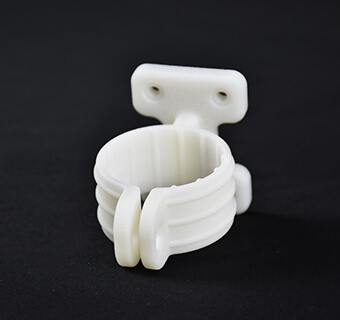
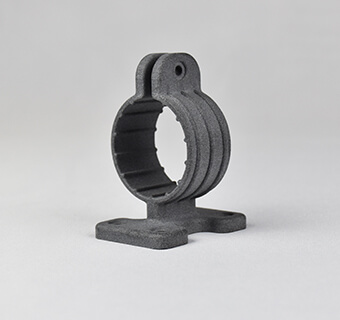
In additive manufacturing, PA11 is processed using SLS (Selective Laser Sintering) and HP Multi Jet Fusion, powder‑based technologies that deliver accurate, functional parts suitable for both prototyping and series production.
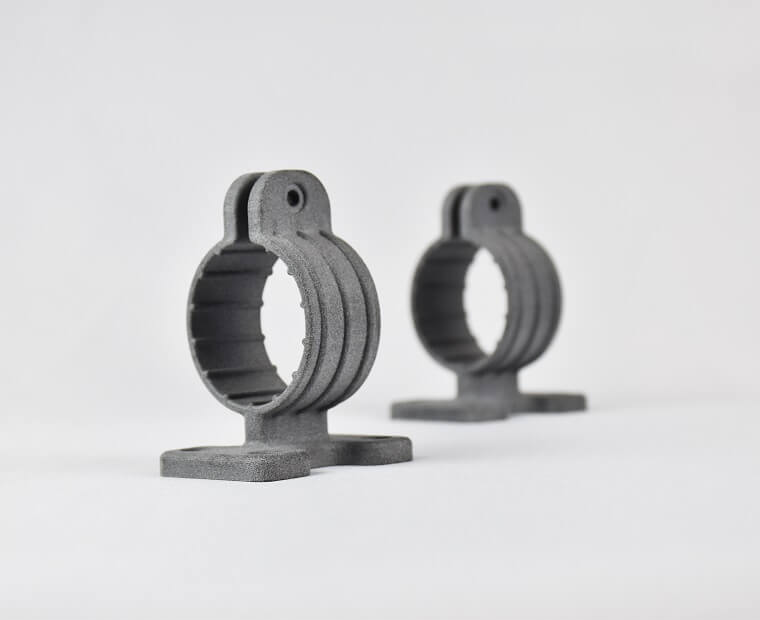
Whether you need functional prototypes or series‑production parts, 3D printing in PA11 allows you to manufacture durable, impact‑resistant components with good temperature resistance and excellent fatigue performance.
Resistance and ductility
PA11 stands out for its very high toughness and large ductility, with un‑notched Charpy impact values around 180–200 kJ/m² depending on orientation, making it ideal for parts exposed to impacts.
Long‑term durability
This material combines strong mechanical performance, good wear resistance and high‑cycle fatigue resistance, ensuring durable behavior under repeated loading or in demanding industrial environments.
Thermal stability
PA11 offers good thermal resistance, with a heat deflection temperature under load (HDT B) exceeding 170 °C at 0.45 MPa for certain grades, suitable for more demanding thermal environments than standard plastics.
Moisture resistance
PA11 shows strong resistance to oils, greases and a wide range of chemicals, as well as good behavior in humid environments, making it suitable for outdoor, industrial or skin‑contact applications.
Precision Manufacturing
PA11 3D‑printed parts feature fine details, consistent quality and tight tolerances, with wall thicknesses down to around 0.8–1 mm depending on process and variant (SLS or MJF).
Design Versatility
From standard ductile PA11 to stiff PA11 CF and ESD‑safe PA11, the family of grades lets you adjust rigidity, weight, electrostatic dissipation and mechanical performance for each project.
High impact resistance and excellent ductility for functional parts under dynamic or repeated loading.
Bio‑based, sourced from renewable resources, making it more sustainable than fossil‑based polyamides.
Strong resistance to chemicals and moisture, suitable for industrial, outdoor and some skin‑contact environments.
Wide range of variants (standard, CF, ESD, HP MJF) to fine‑tune stiffness, weight, ESD protection and mechanical performance.
Compatible with SLS and HP Multi Jet Fusion, enabling fast prototyping and scalable production with consistent quality.
PA11 is a high‑performance, bio‑based polyamide that combines mechanical strength, ductility and long‑term durability, making it particularly interesting for technical functional parts.
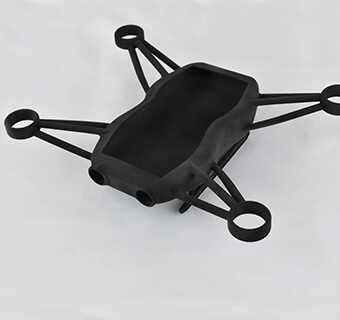
3D printing with PA11 opens up wide possibilities, from impact‑resistant prototypes to lightweight series‑production parts and customized devices for medical, mobility or electronics industries.
Its ability to handle shocks, live hinges and aggressive environments makes PA11 a versatile choice across many sectors.
Professional 3D printing services, offering grades such as Ultrasint® PA11, PA11 CF, PA11 ESD and PA11 HP, provide high‑quality parts without any need for in‑house machines and with optimized process parameters for each application.
By leveraging PA11 3D printing, companies can speed up prototyping, secure their supply chains and develop customized, high‑performance solutions using a more sustainable and stronger material.
When choosing a material for 3D printing, understanding how PA11 compares to other common polymers is essential. Each material offers specific mechanical and functional properties that make it better suited for certain applications.
| Property | PA11 Ultrasint® (SLS) | PA11 HP (MJF) | Ultrasint® PA11 CF (SLS) | Ultrasint® PA11 ESD (SLS) | TPU (SLS/MJF) | PA12 (SLS/MJF) |
| Flexibility | Moderate, highly ductile | Moderate, high ductility | Low, stiff and reinforced | Moderate, balanced elasticity | Very high, rubber‑like | Moderate, semi‑rigid |
| Tensile Strength (MPa) | 45–52 (XY/Z) | 54 (XY/Z) | 71–82 (XY/Z) | 55–65 (XY/Z) | 8–9 | 45–48 |
| Impact Resistance | Very high (184 kJ/m² unnotched XY) | Very high (198 kJ/m²) | High (54–63 kJ/m² unnotched) | Moderate (6.6–7.3 kJ/m²) | No break | Good |
| Durability | Excellent fatigue resistance | Excellent under stress | Superior stiffness/longevity | Good mechanical/thermal | Excellent abrasion/wear | Good chemical/thermal |
| Chemical Resistance | Very good (oils, moisture) | Very good | High | Good | Good (oils/greases) | Excellent (oils, solvents) |
| Typical Applications | Functional prototypes, medical, hinges | Skin contact, automotive interiors, living hinges | Structural/lightweight metal replacement | ESD‑safe electronics, tools | Flexible joints, shock absorption | General prototypes, housings |
PA11 is the material of choice when you need a balanced mix of mechanical strength, ductility, durability and lower environmental impact, whereas TPU is preferred for extreme elasticity and reinforced polyamides are selected for maximum stiffness.
| Property | PA11 SLS (Ultrasint®) | PA11 HP (MJF) | PA11 CF SLS (Ultrasint®) | PA11 ESD SLS (Ultrasint®) |
| Max build size | ≈ 260 × 260 × 260 mm | ≈ 274 × 370 × 380 mm | ≈ 260 × 260 × 260 mm | ≈ 260 × 260 × 260 mm |
| Density | ≈ 1.02 g/cm³ | ≈ 1.05 g/cm³ | ≈ 1.14 g/cm³ | ≈ 1.05 g/cm³ |
| Tensile strength (XY/Z) | 48/42 MPa | 54/54 MPa | 82/71 MPa | 65/55 MPa |
| Tensile modulus (XY/Z) | 1700/1600 MPa | 1800/1700 MPa | 7800/6800 MPa | 2100/1900 MPa |
| Elongation at break (XY/Z) | 35/40% | 40/25% | 4/3% | 20/15% |
| Charpy impact (unnotched XY/Z) | 184/160 kJ/m² | 198 kJ/m² | 63/54 kJ/m² | 7.3/6.6 kJ/m² |

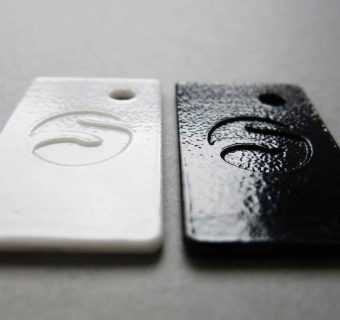
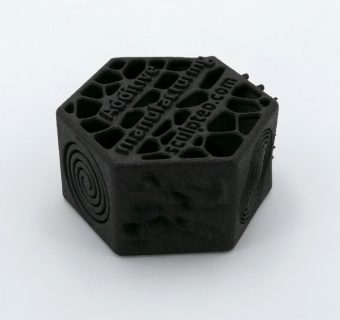
Using HP and SLS you can access some nice finishing option to give your an unique look and a high quality surface to your 3D printed parts

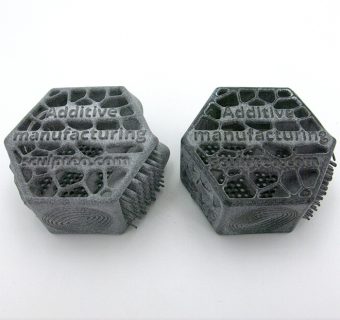
No minimum order quantity. Sculpteo accepts single prototypes up to 10,000+ parts, with instant quoting for any volume.
Use STL or OBJ format with watertight geometry. Minimum wall thickness 0.8–1 mm; avoid sharp corners in load-bearing areas. Follow standard powder-bed guidelines: uniform wall thickness >1 mm, no overhangs >45° unsupported.
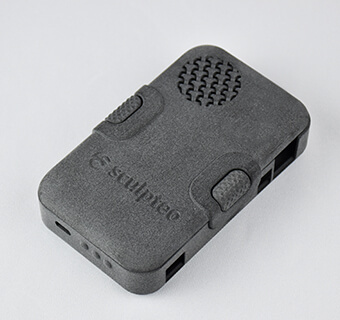
Yes, PA11 and its variants (CF, ESD, HP) suit functional end-use parts like medical orthoses, automotive components, ESD-safe electronics housings, and lightweight structures due to high impact resistance and durability.
1–5 business days for prototypes (SLS/MJF), 7–15 days for production runs. Rush options available; exact timing shown in instant quote based on size, quantity, and finish.
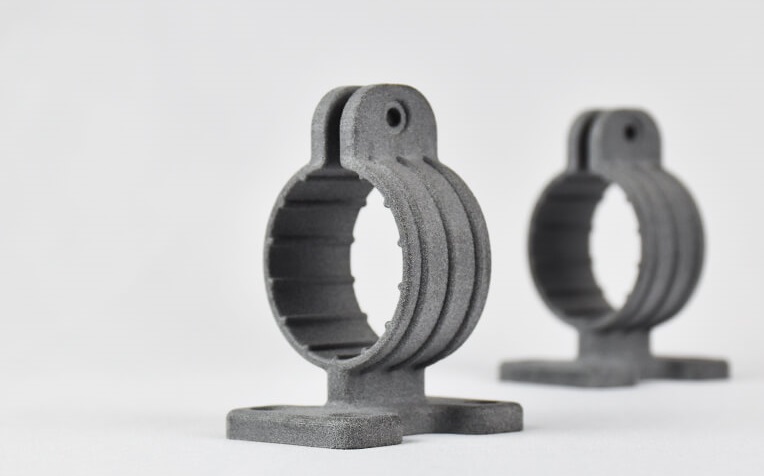
Are you looking for a plastic 3D printing technology? If you are considering MJF and SLS, let’s look more closely at their similarities and differences.
Contact our sales team for your commercial inquiries