
Login
If you have any trouble logging in to your account, contact us.
Sign Up
To start 3D printing or Laser Cutting, you'll need to create an account here. Once done, you'll be able to upload your files and get live quotes of yours parts
Already have an account? Log In
Home » 3D printing by industries » 3D Printed orthoses: A new era in custom healthcare
Orthotics are life-changing medical devices designed to support, stabilize, or correct the human body. Traditionally, their fabrication relied on labor-intensive manual processes, often involving molds, casts, and significant expertise. This made orthotic production slow, costly, and difficult to scale.
With 3D printed orthoses and the rise of 3D printing orthotics, healthcare professionals can now achieve an unprecedented level of personalization. Digital workflows combined with additive manufacturing make it possible to design orthotic devices that fit each patient’s unique anatomy with exceptional precision.
Beyond human healthcare, 3D printing is also opening new possibilities in veterinary medicine, enabling custom prosthetics and accessories that improve animal mobility and quality of life.
3D printing is transforming orthotics by solving many limitations of traditional manufacturing methods. Instead of relying on generic designs, clinicians can now create patient-specific orthotic design faster, more efficiently, and with improved performance.
For healthcare providers, this means more satisfied patients, reduced costs, and a streamlined process. For patients, it translates into devices that are lighter, more comfortable, and better adapted to their daily needs. These are some of the clear advantages of 3D over conventional approaches.
The greatest strength of 3D orthotics lies in mass customization. Using 3D scans or medical imaging, every device can be adapted to the patient’s anatomy. This ensures superior fit, reduced risk of pressure points, and enhanced mobility.
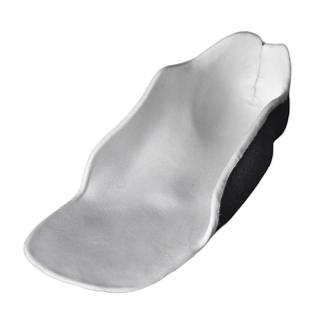
This is particularly relevant for custom foot orthotics, which are tailored to improve gait, reduce pain, and support recovery from musculoskeletal disorders. Patients benefit from devices that address not only posture but also everyday comfort.
To better illustrate the impact of 3D printing in orthotic production, let’s look at a real-world example. Schlather GmbH, a German company specializing in pediatric orthopedic care, partnered with Sculpteo to create Dynamic Foot Orthoses (DFO) using HP Multi Jet Fusion technology and polypropylene. This collaboration shows how 3D printing can transform the manufacturing of custom foot orthotics making them lighter, more flexible, and more comfortable than those produced with traditional manufacturing methods.
To further demonstrate how 3D printing orthotics is reshaping modern healthcare, let’s look at the work of Daniel Robert Orthopedics in Switzerland. The company specializes in orthotic devices, prosthetic devices, and custom foot orthotics, combining traditional expertise with cutting-edge digital tools. By integrating additive manufacturing through their OrthoVoxel® initiative, Daniel Robert Orthopedics delivers 3D orthotics and prostheses that are lighter, more comfortable, and perfectly adapted to each patient’s anatomy. This case study shows the advantages of 3D in achieving mass-customization, repeatable quality, and freedom of orthotic design
Unlike “off-the-shelf” solutions, 3D printed orthoses evolve with the patient’s condition. Adjustments and iterations can be made quickly, making the therapy process more responsive and effective.
Traditional orthotic production requires multiple fittings, molds, and manual adjustments. Each step adds labor, material waste, and expense. By contrast, 3D printing orthotics uses only the necessary material, lowering costs and minimizing waste.
Speed is critical in healthcare. With traditional methods, patients may wait weeks for their device. 3D printing orthotics reduces production time drastically, enabling delivery in days instead of weeks.
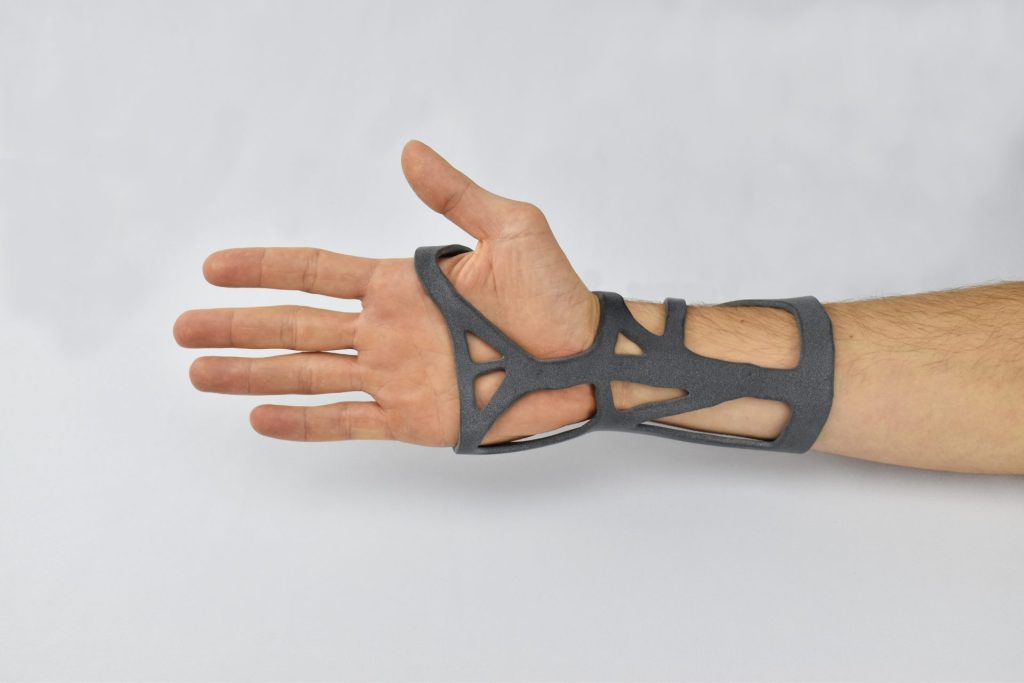
This fast turnaround is vital for patients recovering from surgery or injuries, where timely support accelerates rehabilitation. Quick modifications are also possible when the patient’s condition changes, whether it involves a wrist orthosis, hand orthotic, or foot orthoses.
3D printed orthoses are not just precise, they are also durable and lightweight. Materials like PA11, PA12, or TPU provide excellent mechanical performance while ensuring comfort for daily use.
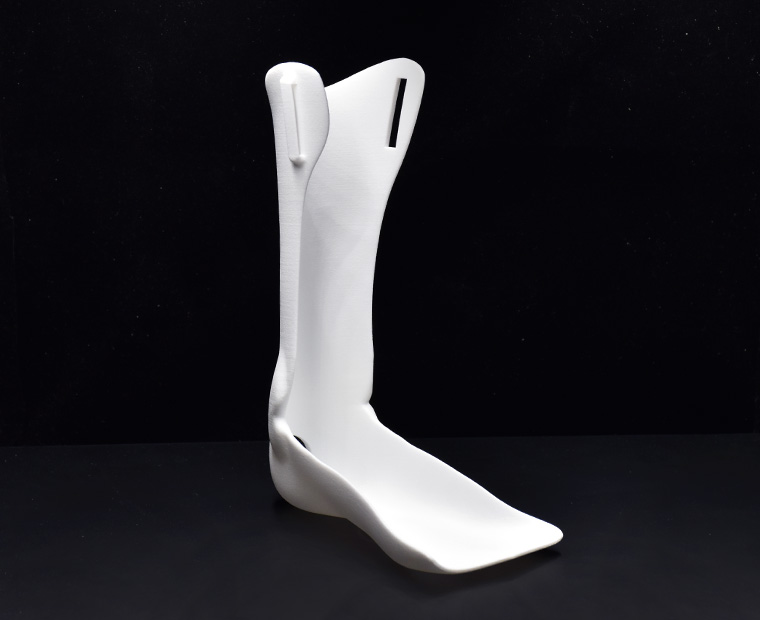
Thanks to lattice structures and ventilation patterns, orthoses are also more breathable and hygienic. Patients benefit from devices that are easier to clean and wear for long periods without discomfort. This is especially valuable in ankle foot orthoses or orthotic insoles, where features such as flexibility and breathability greatly improve patient experience.
Working with an experienced 3D printing service bureau like Sculpteo ensures every step is executed with expertise. From prototping, consulting to final delivery, our team helps healthcare providers and designers optimize designs, select materials, and achieve reliable results.
By outsourcing production to Sculpteo, you also benefit from industrial 3D printers, certified materials, ISO 13485 certified factory and a smooth online ordering process without investing in costly equipment.
Despite the benefits, adopting a digital workflow requires adjustments. Clinicians and technicians may need training in 3D scanning or CAD design. Regulatory frameworks also need to be respected to ensure medical-grade compliance.
Partnering with experts like Sculpteo makes this transition smoother. We provide not just printing services but also consulting and design support to help professionals integrate 3D printing into their practice effectively.
Medical devices must comply with strict safety and quality standards. Not all 3D printing materials are suitable for skin contact. At Sculpteo, we work with certified materials such as PA11 and PA12, ensuring that printed orthoses meet the necessary requirements for medical applications.
By following established regulations, providers can confidently deliver devices that are safe, effective, and ready for clinical use.
The adoption of 3D printed orthoses marks a turning point in orthotic care. Faster, more affordable, and infinitely customizable, additive manufacturing empowers healthcare providers and improves patient outcomes.
At Sculpteo, we believe this shift is not just an option it is the future of 3D printing orthotics.
3D printed orthoses are custom-made medical devices produced with additive manufacturing to support, correct, or stabilize parts of the body.
The advantages include faster production, lower costs, personalized fit, lightweight design, and improved comfort compared to traditional methods.
Yes. 3D printing is ideal for custom foot orthotics and insoles, offering superior comfort, reduced pain, and tailored support for each patient.
Production time can be reduced from weeks to just a few days, depending on design complexity and finishing requirements.
Yes, when manufactured with certified materials like PA11 or PA12 and following regulations, 3D printed orthoses are safe and effective for patients.
Get the latest 3D printing news delivered right to your inbox
Subscribe to our newsletter to hear about the latest 3D printing technologies, applications, materials, and software.
Connect with Google
Connect with Facebook